If you're new to hiring a Filipino domestic helper, you might assume that going direct hire means cutting out the middleman and saving money. Logical assumption. The reality is a lot less satisfying.
You Still Need an Agency -- And Not Just Any Agency
In Singapore, you cannot directly hire a domestic worker from the Philippines without engaging a licensed maid agency. The Philippine government requires accredited agencies to handle all outbound worker documentation -- and most agencies in Singapore are not accredited by the Philippines to do this. That narrows your options significantly. If you're going this route, make sure the agency you engage specifically holds Philippine accreditation before committing.
The Actual Numbers
Here's a real fee schedule from a local agency, showing what you actually pay for both routes (all fees in SGD, excluding airticket, BGPA and GST):
| Fee Item | Filipino Agency (Fresh) | Direct Hire (Fresh) |
|---|---|---|
| Agency / Placement Fee | $1,200 | $800 |
| MOM Work Permit Application | $35 | $35 |
| MOM Work Permit Issuance | $35 | $35 |
| Medical Examination | $80 | $80 |
| Logistics & Accommodation | $300 | $300 |
| Embassy Documentation | $300 | $300 |
| Settling-In Course (SIP) | $76 | $76 |
| Overseas Worker Clearance | $900 | $900 |
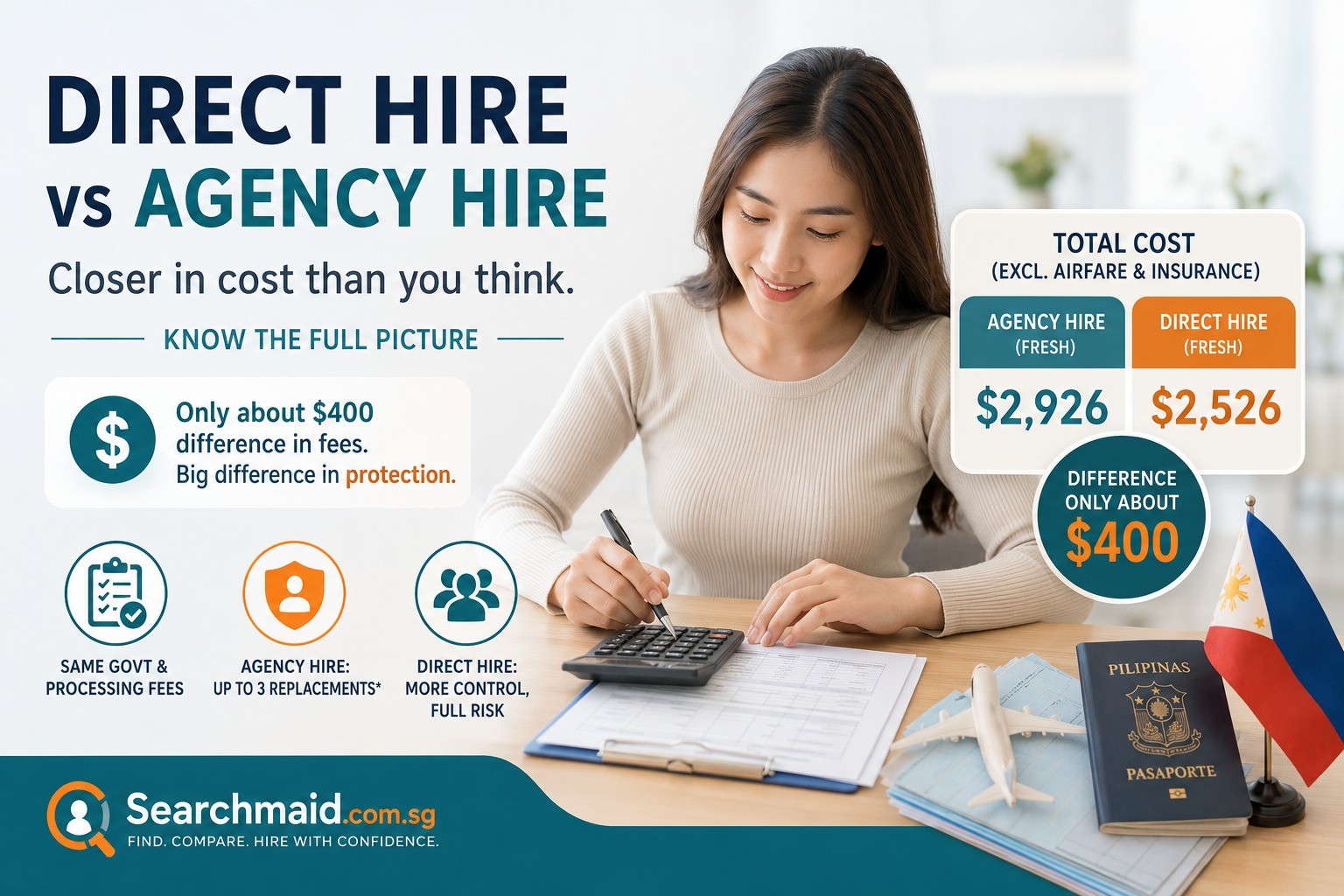
| Total (excl. airfare & insurance) | $2,926 | $2,526 |
Add airfare ($200--$400) and insurance/BGPA ($500--$700) on top of either route and you're looking at $3,200 to $4,000 all in.
The difference between agency hire and direct hire? About $400. That's it.
Where the Money Actually Goes
The $800 agency fee on a direct hire isn't arbitrary. A maid agency contact who handles both types explained it plainly: his agency still needs to house and feed the helper in the Philippines for 6 to 8 weeks while her OEC documentation is processed. Every step takes time. The agency also prepares and submits the embassy contract, then couriers it to the Philippines for her signature -- before she can board a plane.
During that stay, agencies typically conduct pre-departure training as well, though direct hire candidates sometimes resist this since they're already placed and feel less beholden to the agency's programme.
None of that cost disappears just because she's coming to you instead of from their pool.
What You're Actually Giving Up
Here's where the real difference shows up -- not in price, but in protection.
With a standard agency placement, you typically get up to 3 replacements within 6 months if the placement doesn't work out (terms apply).
With a direct hire, you get zero replacements. If it doesn't work out, you start from scratch and pay again.
One more thing worth knowing: there are no maid loans available for Filipino helpers. The full cost comes out of pocket upfront, whichever route you take.
The Bottom Line
Direct hire and agency hire are closer in cost than most people expect. The government and processing fees are identical across both routes -- the main difference is the agency placement fee, which works out to roughly $400 less for a direct hire.
Whether that tradeoff is worth it depends on your situation. Agency hire gives you a safety net in the form of replacements if things don't work out. Direct hire gives you more control over who you're bringing in -- but you carry the full risk if the placement doesn't go smoothly.
Neither option is wrong. Just make sure you're comparing the full picture, not just the headline number.